



Valldemossa

Pueblos de mallorca

History

Valldemossa lies in a valley of the Serra de Tramuntana that has been inhabited since prehistoric times. Under Islamic rule, rural estates used systems for collecting and distributing water. The place name is traditionally associated with the “valley of Mussa”. After the Christian conquest, the valley became part of Mallorca’s feudal lands.

Jaume II established a royal residence in the early 14th century that later became associated with his son Sanç. In 1399 the complex passed to the Carthusian monks, who remained until the dissolution of 1835. The monastery is still Valldemossa’s best-known historic site.

In the winter of 1838–1839, Frédéric Chopin and George Sand lived in Valldemossa. Their stay helped bring the village and the romantic landscape of the Tramuntana to international attention. Santa Catalina Thomàs, born here in 1531, remains another central figure in local life.

Tourism grew in the 20th century, bringing more pressure on the old centre and its access roads. Valldemossa is also part of the Serra de Tramuntana Cultural Landscape, inscribed by UNESCO in 2011 for its agricultural terraces, water systems and dry-stone construction.

Culture and heritage

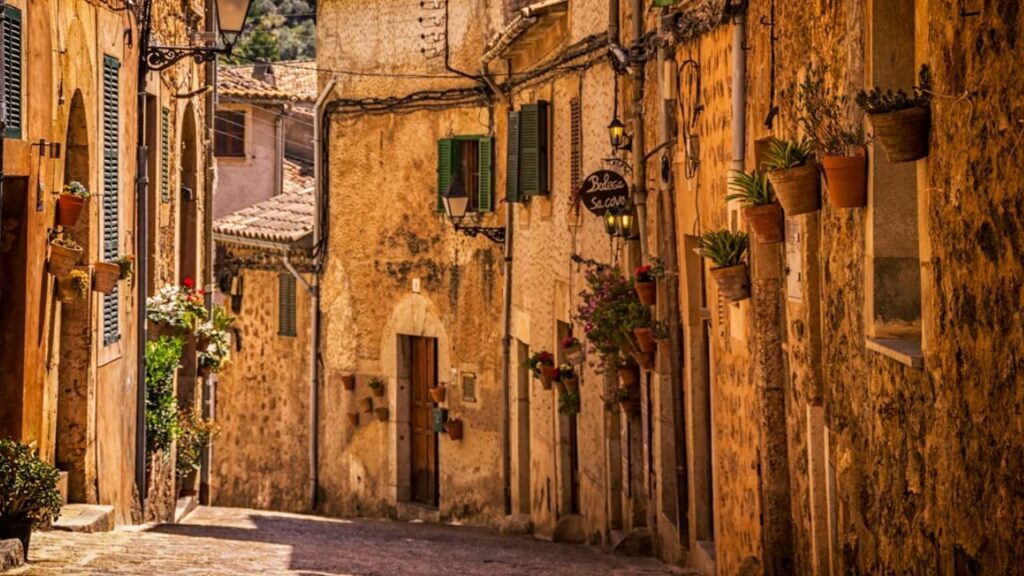
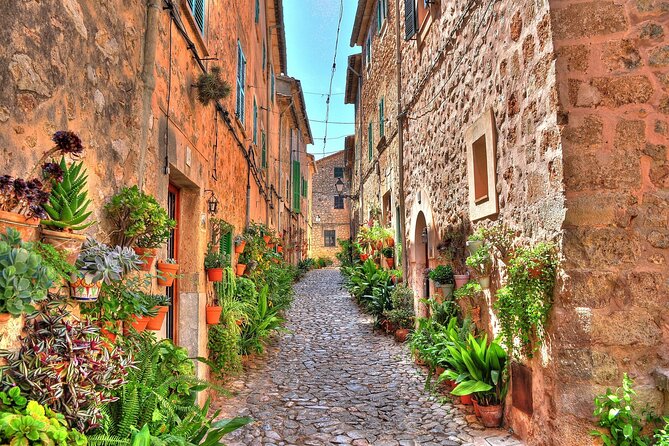
The monastery, King Sanç’s palace, the gardens and the streets around them form the historic heart of Valldemossa. Look for stone façades, window pots, shrines to Santa Catalina Thomàs and small courtyards. These are still the streets and homes of a working village.

Concerts associated with Chopin are part of a cultural calendar that also includes exhibitions and local festivals. Look for traditional stonework and woodwork, as well as olive oil, almonds and pastries from the Tramuntana.

Serra de Tramuntana: the terraces, paths and water channels around Valldemossa help explain the mountains’ World Heritage designation.

Santa Catalina Thomàs: painted tiles throughout the village recall the local saint, and festivities in her honour remain part of the calendar.

The monastery: its buildings have served as a royal residence and a Carthusian monastery, and later as private and cultural spaces associated with writers, travellers and musicians.

compras Valldemossa

Shopping for local produce

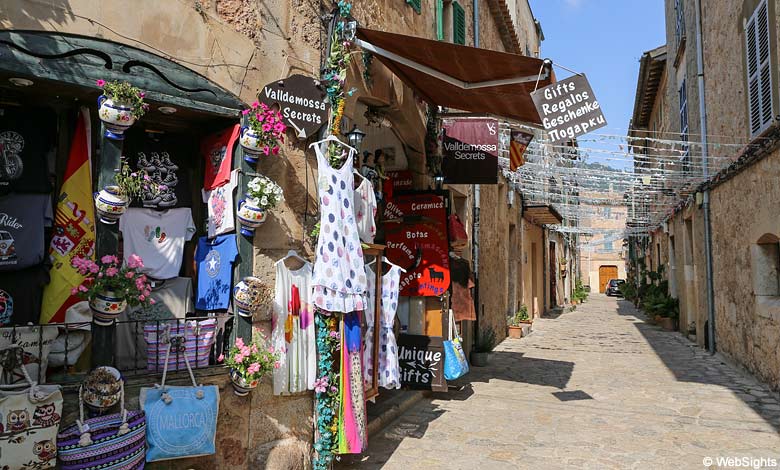
Local shops sell crafts, food and souvenirs. Check the origin if you are looking for locally produced olive oil, olives, almonds, honey, pottery or olive-wood pieces.

Try a coca de patata, the soft potato bun most closely associated with Valldemossa, at one of its bakeries or cafés. In high season the centre is busiest in the middle of the day; an earlier visit leaves more time to browse.

Staying and living in Valldemossa

Accommodation includes small hotels, village houses and rural properties. The old centre is easy to explore on foot, but some streets are steep and narrow. Check parking and easy access before booking.

Life in Valldemossa is closely tied to the mountains and to the visitor season. When considering an older home, check insulation, damp, roof condition and permitted renovations. On land outside the centre, assess retaining walls, access and the work needed to maintain outdoor spaces.

For a year-round home, consider daily services, transport to Palma and how mountain roads affect access in poor weather.

Port de Valldemossa y costa de la Tramuntana

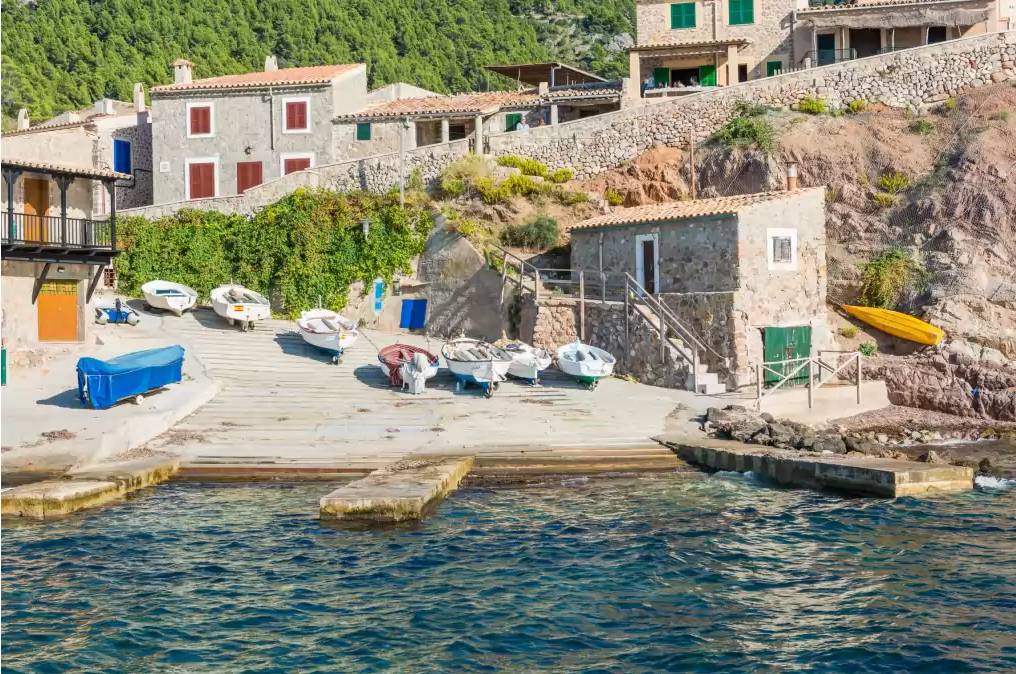
Port de Valldemossa, Sa Marina

At the foot of the cliffs, a winding road ends at Port de Valldemossa, about six kilometres from the village. Beside the small quay lies a pebble beach roughly 90 metres long. Fishing houses, a short breakwater, rocky shallows and beds of posidonia seagrass give it a character of its own. There are no beach facilities, although the quay has a restaurant serving traditional seafood.


Getting there

From Valldemossa, follow the signposted turn onto the MA-1131. The road descends for around 5.7–6 km and is narrow, with steep gradients and hairpin bends. Drive slowly and watch for oncoming traffic. Passing places let vehicles give way. Parking near the quay is limited. 

What’s waiting for you?

  • The shore is pebbly and the water clear and deep. Choose a calm day for a swim; northerly or westerly winds can bring waves.

  • Outside the busiest hours this is a quiet corner of the Tramuntana, with cliffs, holm oaks and the smell of salt in the air.

  • Food: Es Port, by the harbour, is known for its rice dishes and fish. Book ahead in season.

  • Nearby walk: the historic path to s’Estaca starts from the approach road and leads towards the estate associated with the archduke. illesbalears.travel

Practical Tips

  • If you are driving in summer, avoid the busiest hours. There is little room at the harbour.

  • Footwear: the rounded pebbles can be slippery. Water shoes are useful if you plan to swim.

  • There is no lifeguard, parasol hire or sunbed service. Bring water and sun protection, and take your rubbish away with you.

  • If you are uncomfortable driving on narrow mountain roads, visit the village first and leave the port for a quieter day.

LOCAL HOUSING INFORMATION

Housing in Valldemossa

Municipal figures give a general picture of the market. Averages cannot value an individual home or distinguish between neighbourhoods.

SALE

Homes for sale

Regional 4,237 €/m² 2025
Fotocasa 5,409 €/m² October 2026

Each source uses its own period and methodology. Figures are shown separately.

RENT

Homes for rent

Official 6.93 €/m²/month 2024
Fotocasa 19 €/m²/month October 2026

Each source uses its own period and methodology. Figures are shown separately.

Local editorial information reviewed on 11 de November de 2026. Each source states the period covered by its market figures.

Start typing and press Enter to search