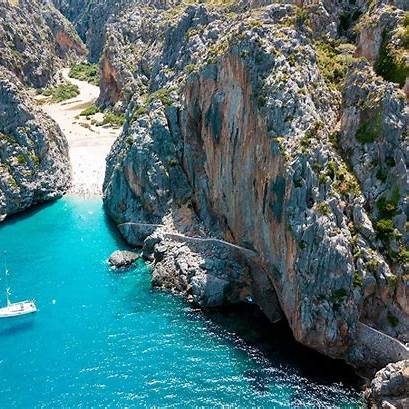
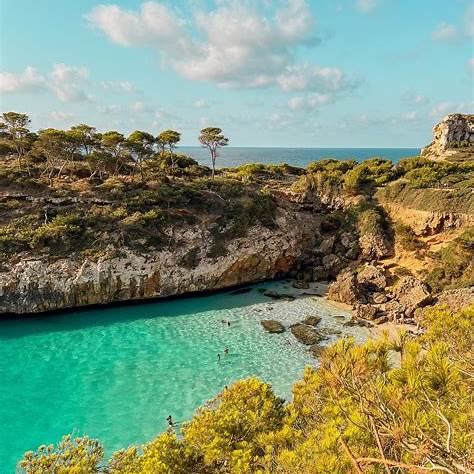
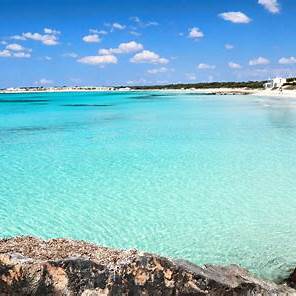
Save this guide to plan your days from cove to cove. I’ll start with a representative gallery (Sa Calobra, Caló des Moro, Es Trenc) and below that, you’ll find 20 beaches with a brief description and directions on how to get there by car.
1) Es Trenc (Campos)
White sand, Caribbean waters, and protected dunes; the essence of a wild beach.
How to get there: From Palma, take the MA-19 towards Campos and turn off towards Colònia de Sant Jordi. Signposted access (Ses Covetes / Ses Salines). Paid parking and a 5–10 min walk along footbridges.
2) Caló des Moro (Santanyí)
A photogenic, small, turquoise cove nestled between cliffs.
How to get there: Palma → Ma-19 → Santanyí → Cala Llombards. Leave your car in the Cala Llombards car park and walk 15–20 minutes along the trail. Very limited capacity.
3) S’Amarador (Parc Natural de Mondragó)
Large bay with fine sand and pine forest, within the natural park.
How to get there: Palma → Ma-19 → Santanyí. Follow signs for Parc Natural de Mondragó (S’Amarador parking lot). Short and easy trail.
4) Cala Mondragó / Sa Font de n’Alis (Santanyí)
Sister of S’Amarador; more services without losing charm.
How to get there: Same as S’Amarador, but signposted as Cala Mondragó. Parking a few minutes’ walk away.
5) Playa de Muro (Muro)
Six kilometers of white sand and calm waters; perfect for families.
How to get there: Palma → Ma-13 to Alcúdia; follow signs for Playa de Muro. Several parking areas (Es Comú / Es Capellans).
6) Formentor (Pollença)
Pine trees stretching to the shore and views of the Tramuntana mountains.
How to get there: Drive to Port de Pollença and continue along the Formentor road. Access restrictions may apply in summer; consider taking the shuttle/bus from Port de Pollença.
7) Cala Agulla (Cala Ratjada)
Spacious, surrounded by pine forests, clean waters, and discreet beach bars.
How to get there: Palma → Ma-15 towards Capdepera → Cala Ratjada → signs for Cala Agulla. Large parking lot behind.
8) Cala Mesquida (Capdepera)
Dunes, moderate waves, and a wilder atmosphere.
How to get there: From Capdepera, follow signs for Cala Mesquida (10–15 min). Parking next to the residential area and direct access.
9) Cala Torta (Artà)
Virgin and windless, ideal when the sea is calm.
How to get there: Artà → local road to Cala Torta (narrow and bumpy final stretch). Dirt parking lot and 10–15 min walk.
10) Cala Varques (Manacor)
Postcards of golden rock, natural arches, and emerald water.
How to get there: Between Porto Cristo and Portocolom on the MA-4014. Park where permitted and walk 25–30 minutes along the marked trail.
11) Cala Llombards (Santanyí)
A picture-perfect cove, larger than Caló des Moro and ideal for swimming.
How to get there: Santanyí → Cala Llombards. Parking at the top and easy descent.
12) Cala Sa Nau (Felanitx/S’Horta)
Sandy spit with pine trees and secondary coves for snorkeling.
How to get there: S’Horta → follow signs for Cala Sa Nau along narrow road. Parking at the top and 5–10 min walk.
13) Cala Deià (Deià)
Rocky, magnetic due to its artistic environment and seaside restaurants.
How to get there: Take the MA-10 to Deià and descend via the local road (winding). Limited parking; 10-minute walk.
14) Sa Calobra & Torrent de Pareis (Escorca)
Monumental canyon that flows into a tongue of gravel and rushing waters.
How to get there: Take the MA-10 to the Sa Calobra turnoff and take the scenic road. Paid parking and a 10-minute walk through pedestrian tunnels. Alternative: boat from Port de Sóller.
15) Cala Tuent (Escorca)
Peaceful, solid, and very authentic; mountains and calm seas.
How to get there: Same turnoff as Sa Calobra and sign for Cala Tuent (narrow road). Parking next to the cove.
16) Illetas (Calvià)
Three urban coves with crystal clear water just a stone’s throw from Palma.
How to get there: Ma-1 exit Illetes. Paid parking and blue zone; convenient option with city bus from Palma.
17) Cala Pi (Llucmajor)
Deep natural moat with golden sand and viewpoints from the cliff.
How to get there: Llucmajor → Ma-6014 towards Cala Pi. Parking in the village and stairs down to the beach.
18) Cala Santanyí (Santanyí)
Familiar, accessible, and with good kayaking/paddleboarding schools.
How to get there: Signposted from Santanyí; park in nearby streets and walk to the beach.
19) Cala Murta (Formentor)
Small and quiet, ideal for reading and snorkeling.
How to get there: Formentor Peninsula; leave your car where permitted and walk 25–30 minutes along a forest track. No services available.
20) Cala del Mago / Portals Vells (Calvià)
Calm waters, light-colored rock, and two adjacent coves; relaxed atmosphere.
How to get there: Ma-1 → Magaluf exit → Portals Vells. Limited parking and a 5–10 min walk.
Quick tips
-
Get up early in summer to park easily and enjoy fewer crowds.
-
Respect the walkways and the posidonia: it is the “forest” that keeps the water so clear.
-
Bring water shoes for rocky coves and cash for rural parking lots.